



Executive Search in Consumer Markets: The C-Suite Competencies Driving Success
8 December 2025
Organizations in the consumer markets sector are navigating an era of unprecedented volatility. Caught between rapidly changing consumer behaviors, intense macroeconomic pressures, and massive technological disruption, the industry faces a high-stakes, low-margin reality. This new landscape demands a profound shift in C-suite leadership, moving beyond traditional expertise to embrace a new set of data-driven, adaptive, and strategic competencies.
In a recent presentation, Jouko Pitkänen, Managing Partner of JFP Executive Search from Finland and Practice Group Leader of Consumer Markets at IIC Partners, explored the key competencies required of executive leaders to succeed in this disrupted environment.
The New Retail Landscape: A High-Pressure Environment
Capturing consumer loyalty and maintaining profitability has become extremely challenging for retail organizations. Here are several key pressures that are redefining the industry:
1. Shifting Share of Wallet: Consumers are increasingly prioritizing travel and out-of-home activities, pulling money away from traditional retail goods.
2. Volatile Consumer Behavior: Preferences are changing faster than ever and are increasingly unpredictable. Consumers now shift their loyalty and spending habits almost overnight, breaking traditional forecasts and creating inventory risks.

3. Macroeconomic Sensitivity: The sector is highly sensitive to capital costs, investor expectations, and general economic conditions. Retailers’ thin operating margins mean that a rise in interest rates directly squeezes profits, while a dip in consumer confidence can halt discretionary spending immediately.
4. Operational Strain: Reliance on a large frontline workforce makes the industry vulnerable to labor market fluctuations, while supply chain disruptions create costly out-of-stock scenarios.
5. Technological Disruption: The rise of e-commerce and new technologies has fundamentally disrupted traditional retail models.
This combination of low margins, high fixed costs, and intense price sensitivity creates a challenging environment. Recent data from Euromonitor illustrates this, showing negative or stagnant growth across major European markets in sectors like furniture, DIY, and consumer electronics. As Pitkänen noted, the only consistent bright spot for growth across the board is pet care.
From ‘Skills’ to ‘Competence’: Redefining Leadership
To navigate this landscape, Pitkänen argues for a more precise understanding of what makes an effective leader. He draws a clear distinction between skills, competence, and talent.
“We quite often mix skills, competencies, and expertise. Sharing clearer definitions with our clients allows us to clarify requirements and find the right leaders.”
In this model, leadership is an entity built from several parts:
- Skills: Specific abilities (e.g., using analytics software).
- Knowledge: Broader understanding (e.g., management theory, industry trends).
- Personality & Social Skills: Inherent traits and interpersonal abilities.
These elements combine to create a competence, such as “problem-solving.”

When competencies are multiplied by commitment (engagement with the role) and contribution (the willingness to share knowledge and elevate the organization), true potential is realized. For C-suite leaders, the most critical foundation for this is self-awareness—knowing their own strengths and weaknesses.

Top C-Suite Competencies for the Future
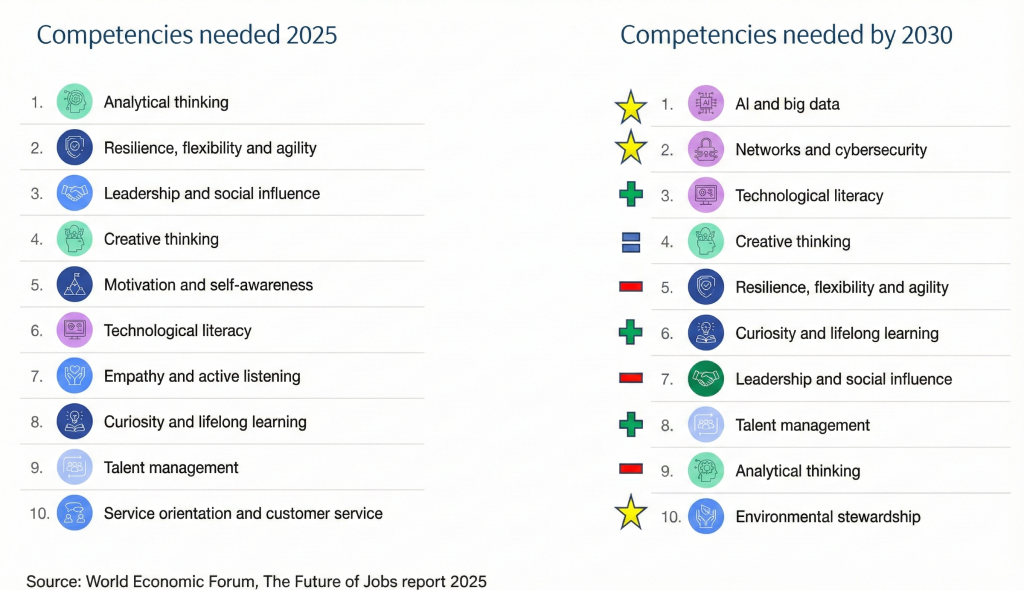
Drawing on data from the World Economic Forum and his own industry analysis, Pitkänen outlined the essential competencies for future C-suite leaders. While foundational skills like leadership and analytical thinking remain important, a new profile is emerging.
1. AI and Big Data Literacy: This has jumped to the top of the list. Leaders must understand how to leverage AI and big data to drive strategy, understand consumers, and optimize operations.
2. Technological Proficiency: This was identified as the second most critical future skill, and includes a deep understanding of digital ecosystems, e-commerce platforms, and cybersecurity.
3. Creativity and Strategic Innovation: With old business models failing, leaders must have the creativity to innovate and develop new strategies to survive and thrive.
4. Adaptability and Resilience: The environment is uncertain, and shocks are inevitable. The best leaders are those who can “bounce back” and guide their organizations through intense volatility.
5. Curiosity and lifelong learning: This competency has evolved to include micro-learning and rapid knowledge orchestration using AI tools. A curious, open and futurist mindset is essential, allowing leaders to equip themselves with all the tools necessary to stay competitive.
6. Leadership and Communication: As technology advances, the human element of leadership becomes more critical. Leaders must be able to communicate, inspire, and manage people through constant change.
7. Sustainability and Environmental Stewardship: While improving sustainability has long been a priority for retail organizations, it has now evolved into a critical business imperative. The pressure on leaders to deliver impact has risen dramatically, driven by new regulations, investor activism, and consumer demands.
Sustainability: From ‘Nice-to-Have’ to ‘Table Stakes’
The role of sustainability in business has fundamentally changed. What was once defined as a competitive edge has now become a matter of core risk management.
“If something negative happens in sustainability or environmental impact, it can become a huge reputation threat for the company,” Pitkänen explained. “Every organization must already operate at a certain level and continually drive for improvement.”
For consumer companies with supply chains that stretch around the world, the ability to track products, ensure ethical production, and validate workers’ pay is no longer optional. The bar is continuously rising, and a failure to meet these expectations represents an immediate and significant business risk.
Looking Ahead: The Future of Consumer Leadership
The old retail playbook is obsolete. The future of the consumer market will be led by C-suite executives who are technologically fluent, highly adaptable, and experts in human-centric leadership.
Finding these transformative individuals requires a deep, nuanced understanding of the industry along with advanced leadership assessment techniques. As the market continues to evolve, the demand for leaders who can manage disruption, risk, and innovation will only intensify.
Learn more about our Consumer Markets Practice Group >>
Lead Contributor:
Jouko Pitkänen, Managing Partner, JFP Executive Search, Helsinki