



Nordic Leadership Report: Gender Diversity in CEO and Board Roles
25 June 2025

Across Europe, momentum continues to build around gender diversity in board and executive roles. Legislation, social expectations, and shifting business priorities are all contributing to a more inclusive corporate landscape.
In the Nordic region, a long-standing commitment to diversity and inclusion has helped drive measurable progress in this area.
Within this context, executive search firms are key drivers of impact. By advising on leadership strategy, broadening succession pipelines, and guiding inclusive selection processes, they help organizations align top-level hiring with long-term diversity goals.
This report brings together data, case studies, and expert insights from IIC Partners firms in Sweden, Norway, Denmark, and Finland. It reflects the progress made, the strategies that are working, and the areas where challenges persist.
I hope you find this report both inspiring and informative, and that it sparks further action towards gender diversity at the board and executive level.
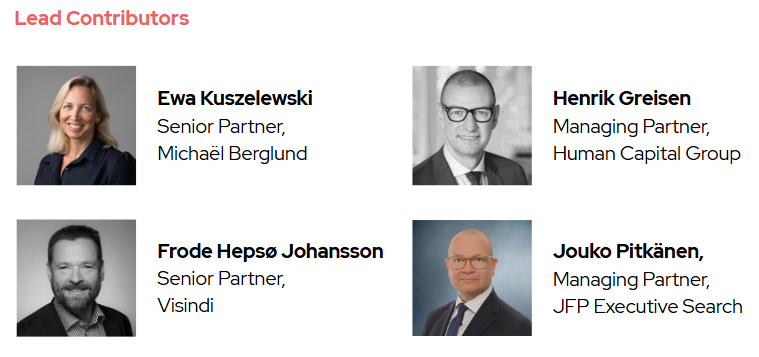
– Ewa Kuszelewski, Senior Partner, Michaël Berglund
02. Gender Diversity in European Leadership
In recent years, European countries have made remarkable progress in gender diversity on corporate boards. According to a 2023 study of publicly listed companies in the STOXX Europe 600, women now hold 40% of board seats—up from just 22% in 2014.¹ This achievement is the result of proactive policy-making and a growing recognition of the value that diverse leadership brings to business performance.
Despite this progress, women remain significantly underrepresented in CEO roles, holding just 8% of such positions across Europe. While this marks an increase from 4.4% in 2014, the numbers remain stark, underscoring the need for continued action.²

IIC Partners firms are actively working to change this by advocating for more inclusive hiring practices and looking holistically at the barriers to progression.
“Gender, but also industry diversity in the Management teams, is an important factor in the diversity discussion. We must enable best practices to move from one industry to another.” — Jouko Pitkänen, Managing Partner, JFP Executive Search
Expanding our vision of what makes leaders qualified and removing barriers that reduce talent pools allows gender diversity efforts to flourish. This is particularly true for industries that have low female representation.
“We should all try to expand the candidate pipeline and challenge the ‘lack of qualified women’ narrative.” — Henrik Greisen, Managing Partner, Human Capital Group
While there is still work to be done, the growing representation of women in leadership and the progress driven by search firms is encouraging.
03. Recent Appointments: Making an Impact
Executive search firms have played a central role in facilitating meaningful placements that improve boardroom and C-suite diversity and drive business performance. Here are some recent case studies from IIC Partners firms.
JFP Executive Search: Board Director, Energy Company, Finland
JFP Executive Search placed a first-time female board member with deep operational finance expertise on the board of a publicly owned large energy company. This appointment supported the organization’s minimum 40/60 gender diversity policy. The selected candidate was younger than most sitting members, bringing both technical skills and a new strategic perspective. JFP conducted a thorough search process, during which 27 candidates were evaluated who fit the profile.
A highly skilled research team is essential when the profile of a board member is precisely defined and specialist expertise is required. A strong research team is the foundation of successful executive search assignments.

Michaël Berglund: Chairperson and CEO, Tech Company, Sweden
Michaël Berglund recently supported a global tech company through transformative change after the chairperson resigned. All major shareholders were represented on the board, thereby a strong leader capable of unifying the board’s perspectives was required. Michaël Berglund presented a slate of 22 candidates, comprising 10 men and 12 women. Following an extensive series of interviews, the client ultimately selected a woman with a CEO background who possessed a number of directorships.
Once the new chairperson was onboarded, she commenced the search for a new CEO. Michaël Berglund provided a shortlist of five men and five women. Following the selection process, the client arrived at three final candidates, all of whom were women, with one being selected as the new CEO. Since the appointment of the new chairperson a year ago — and the CEO six months later — the company’s stock price has risen by a total of 64%.
Human Capital Group: CEO, Life & Pension Fund, Denmark
Faced with intense regulatory scrutiny and a historically male-dominated executive pool, Human Capital Group placed the first-ever female CEO of a major Life & Pension fund in Denmark. The board was motivated by a desire to reflect its predominantly female membership and bring in an empathic leader who could navigate complex transformation. The successful candidate’s collaborative leadership style and transparent approach were pivotal in driving organizational change.
Visindi: Chair, Energy Company, Norway
In Norway, where legislation mandates a minimum 40% female representation on boards, Visindi conducted a national search to appoint a female Chair to a medium-sized energy company. The role demanded a candidate with substantial board and international C-suite experience. Despite a narrow field, Visindi delivered a successful outcome by identifying a recently retired CEO from a multinational company who was prepared to step into a governance role and bring strategic clarity.

04. First-Time Board and CEO Leaders: Success Factors
Bringing new talent into leadership roles, particularly women who are stepping into board or CEO positions for the first time, has become a strategic priority. These leaders often bring strong motivation to succeed at the higher level, along with new ideas and perspectives.
“We often source first-time CEO candidates from executives one level below the CEO. These individuals bring high motivation to their role, with new ideas and fresh energy.” — Frode Hepsø Johansson, Managing Partner, Visindi
Jouko Pitkänen, Managing Partner, JFP Executive Search, noted a similar experience after a recent successful search: “The selected candidate was highly motivated to advance to the next stage of her career and the placement was extremely successful.” It is clear that previous experience in the CEO role is not a prerequisite for success.
Henrik Greisen, Managing Partner, Human Capital Group, emphasized that many of their CEO placements are first-time female leaders who distinguish themselves by their communication skills, openness with stakeholders, and high levels of empathy. These traits are often undervalued but essential for success, especially during organizational change.

05. Key Statistics from IIC Partners Firms in the Nordics
The statistics shared by our member firms demonstrate incredible progress toward gender diversity at the highest levels of leadership.
Michaël Berglund: 47% of all placements are women. Among these, 79% remain in post for at least three years, demonstrating strong retention.
Visindi: 40–44% of placements at the C-suite and board levels over the last four years have been women. Visindi places approximately 350 executives annually.
JFP Executive Search: Over the past two years, 40-50% of board searches have specifically focused on women, driven by legislative change and boardroom strategy.
Human Capital Group: There is a 12% higher retention rate among female placements (average tenure: 4.7 years), and a near-parity promotion rate between male and female executives (39% vs. 41%) after being placed.
06. The Impact of Gender-Diverse Leadership
Across our Nordic firms, there is strong agreement: gender-diverse leadership delivers measurable and meaningful benefits for organizations. These benefits span strategic decision-making, organizational culture, governance integrity, and market reputation. The evidence, drawn from numerous high-level placements and board transformations, illustrates that gender diversity at the top is not simply a metric to be achieved—it is a driver of long-term business success.
Strategic Agility
Firms contributing to this report shared that in their experience, organizations with gender-diverse leadership teams often respond more effectively to market changes and global challenges. These teams are quicker to embrace ESG goals, adopt innovative technologies, and pivot strategically when required.
“Inclusion fosters innovation and creativity, contributing to a more dynamic and resilient organizational culture.” — Ewa Kuszelewski, Senior Partner, Michaël Berglund
Stronger Performance
Numerous studies have found a positive correlation between gender-diverse leadership teams and improved financial performance. IIC Partners firms echoed these findings in practice, noting that clients with diverse leadership often have better shareholder returns.³
“Gender-diverse executive teams have been linked with better returns on equity and stock performance. Reports show that Fortune 500 companies with the highest female representation in leadership significantly outperform those with the lowest.” — Henrik Greisen, Managing Partner, Human Capital Group
Healthier Workplace Cultures
Companies with women in leadership roles are more likely to cultivate inclusive cultures, with higher employee satisfaction and retention rates. Research also shows that gender-diverse leadership teams are more likely to support flexible work policies and family-friendly practices.⁴ ⁵
“Diverse teams make better and more sustainable decisions and increase value creation. Decision-making also better takes into account the human factor.” — Jouko Pitkänen, Managing Partner, JFP Executive Search
Improved Governance and Risk Management
Gender-diverse boards have been observed to demonstrate stronger performance in audit, risk oversight, and regulatory compliance. They are also more likely to engage in rigorous strategic discussions and ask more challenging questions, ultimately enhancing accountability and ethical standards.⁶ ⁷ ⁸
Enhanced Market Reputation
Companies led by diverse executive teams can have stronger reputations with investors, partners, and prospective employees. A commitment to gender equality reinforces perceptions of the company as modern, ethical, and forward-thinking. This reputational strength can translate into a competitive advantage in both talent acquisition and stakeholder engagement.⁹
“Diverse organizations are more effective, achieve better results, have improved market and stakeholder reputations, and are more attractive employers.” — Frode Hepsø Johansson, Managing Partner, Visindi
Taken together, these insights reflect a clear and consistent trend: gender-diverse leadership is not only beneficial — it is essential for organizations striving for innovation, resilience, and sustainable growth.

07. Inclusive Search Processes: Best Practices
Achieving greater gender diversity in leadership roles requires structured, proactive, and accountable search methods. The best practices outlined below have been implemented by our firms and are continually evolving, including:
Client Collaboration
Consultants engage clients early and often in meaningful conversations about diversity goals to partner together on achieving a successful outcome.
Diverse Sourcing
Firms that prioritize diversity have expansive sources to draw from. They look across multiple sectors, participate in professional groups, contribute to industry forums, and actively build diverse talent pools for current and future assignments.
“Executive Search firms are proactively identifying and engaging leaders, including those who may not be seeking new roles. This expands the pool of qualified candidates beyond traditional sources.” — Ewa Kuszelewski, Senior Partner, Michaël Berglund
Balanced Candidate Slates
Firms proactively build (and continually balance) gender-diverse candidate slates to ensure the client has ample opportunity to meet diversity needs.
Skills Ahead of Experience
Role descriptions are written using inclusive language and with an emphasis on skills and competencies, rather than rigid career paths. This widens the candidate pool and reduces barriers for women and other underrepresented groups.
“Executive search firms can help to shape board and executive norms by reframing leadership profiles to value traits like collaboration, resilience, and stakeholder engagement — areas where many female leaders excel. Encourage boards to move away from ‘cloning’ past CEOs and instead prioritize competency over legacy experience.” — Henrik Greisen, Managing Partner, Human Capital Group

Inclusive Interviewing
Structured interviews with competency-based scoring systems help standardize evaluations. Diverse interview panels and staff training further reduce the risk of bias.
Internal Standards
Some firms have internal diversity standards or requirements to ensure accountability. For example, where laws mandate minimum gender representation on boards, shortlists are not presented to the client until those minimums are met.
Thought Leadership
Communicating openly about the benefits of gender diversity in top leadership roles creates social momentum for change.
“We have had several articles on gender diversity getting attention. It helps that Visindi has a female CEO with a strong market position in our business.” — Frode Hepsø Johansson, Managing Partner, Visindi
These practices go beyond compliance — they reflect a strategic shift in how leaders are evaluated and selected. By embedding diversity at every stage of the search, IIC Partners firms are offering their clients a more robust and equitable executive hiring process that benefits both the organization and the candidates involved.
08. A Shared Commitment to Progress
The data and insights captured in this report demonstrate that progress toward gender diversity in leadership roles continues across the Nordic countries and throughout Europe.
IIC Partners firms are contributing to this momentum by embedding inclusive practices into search processes and working closely with clients to broaden candidate pipelines. These actions have led to a measurable increase in female representation at board and CEO levels, as well as more balanced leadership profiles overall.
While we celebrate the milestones achieved, challenges persist — particularly when considering the low representation of women in CEO roles. Continued progress will require close collaboration between search firms and clients, and a long-term commitment to the best practices outlined in this report. By staying focused on these priorities, organizations can build diverse executive teams that reflect the full spectrum of available talent and, in turn, realize the associated performance gains.
About IIC Partners
IIC Partners is a leading provider of executive search and leadership consulting services. Our expert consultants, connected across 40 offices worldwide, partner with senior executives and board directors to transform businesses and solve complex leadership challenges.
References
4. https://www.ccl.org/articles/leading-effectively-articles/7-reasons-want-women-workplace/
5. https://www.catalyst.org/insights/2020/why-diversity-and-inclusion-matter
7. https://link.springer.com/article/10.1007/s10551-023-05553-3
8. https://www.mdpi.com/2227-9091/13/1/11
9. https://pubsonline.informs.org/doi/10.1287/orsc.2022.17098